829,000

people die every year from water-borne disease linked to unsafe water, sanitation and hygiene, 60% of all such deaths worldwide.

Most of it is preventable. The clearest predictor of whether a family drinks, cooks and washes safely is how far they have to walk for water. A hand pump or a well closes that distance for good.

Fund a hand pump, £250Fund a well, £750
photo: community drawing water from new well
Two ways to give

Choose what you want to build

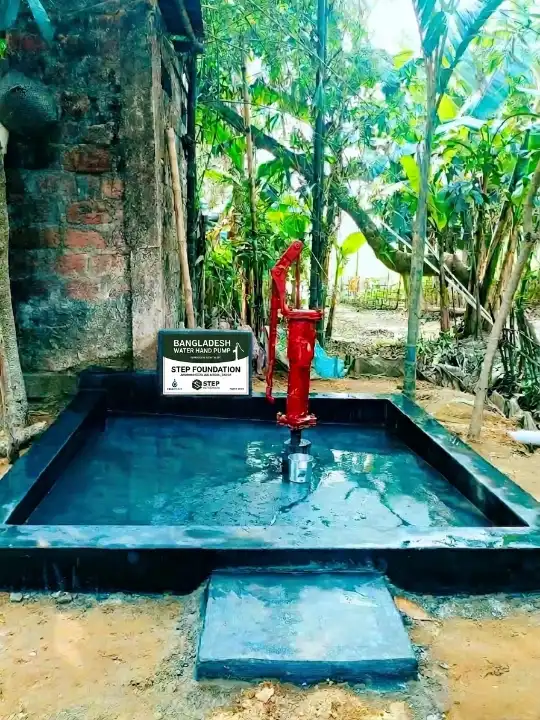
Safe Water is the project we run ourselves. There is no gap between your donation and a pump going into the ground in rural Bangladesh.

hand pump
£250Hand pump

A simple, low-maintenance pump installed close to where families live. Cuts hours off the daily walk for water and serves a cluster of households for years.

Sited with the families who will use it · maintained locally
well construction
£750Well

A community well built to last. Where surface water is unreliable or unsafe, a deep bore reaches clean water further underground, enough for a whole village.

Deep bore where needed · built with the community
£
Donate £750, well

“Whoever digs a well will receive reward as long as any living creature drinks from it”

Ṣaḥīḥ Ibn Khuzaymah, no. 1292
Walk it yourself

Drag the slider to the walk someone makes for water today

These are real WHO access thresholds and measured water-use figures. The classification changes at the boundaries below, mirroring how the evidence is structured.

15 min
Round-trip walk to water
Basic access
Tap at home5 min30 min60+ min
~17 L
used per person, per day
High
WHO level of health concern
Not just thirst

Unsafe water hurts people in five different ways

The World Health Organization classifies water-related disease into five mechanisms. A pump does not just give people something to drink, it interrupts most of these at once.

Waterborne

Caused by drinking contaminated water: water-borne disease, infectious hepatitis.

Access-related

Caused by not having enough water for hygiene. Trachoma, scabies, dysentery.

Water-based

Pathogens that spend part of their life cycle in water. Leptospirosis, cyanobacteria toxins.

Water-related vectors

Insects that breed near water sources. Malaria, onchocerciasis.

System-associated

From engineered water systems themselves. Legionellosis, certain pipe contaminants.

Source: WHO 2020, Table 1 (adapted from Bartram & Hunter, 2015; originally White, Bradley & White, 1972).
What actually works

Every part of a water project earns its keep

Reductions in childhood water-borne disease found in rigorous, randomised or well-controlled studies, pooled across systematic reviews.

Hygiene promotion45%
Fewtrell et al., 2005 (rigorous studies subset)
Water quality and treatment39%
Fewtrell et al., 2005 (rigorous studies subset)
Sanitation access36%
Esrey et al., 1991 (rigorous studies subset)
Handwashing26%
Aiello et al., 2008 (rigorous studies subset)
Water supply access20%
Esrey et al., 1991 (rigorous studies subset)

All figures: WHO 2020, Table 8, reductions in water-borne disease morbidity, restricted to the more methodologically rigorous study subset where reported. A water project usually combines several of these at once, so the effects are not simply additive.

Real-world evidence

Matlab, Bangladesh: seven years, 51,406 households

Researchers tracked childhood water-borne illness against the density of tubewells within 100m of each home from 2000 to 2006. Every step up in nearby well density was associated with meaningfully less disease, and the effect held after controlling for wealth, flooding and education.

It is one of the largest, longest-running datasets connecting well access to child health outcomes.

13%
lower odds of childhood water-borne illness for each step up in nearby well density (OR 0.87, 95% CI 0.85–0.89)
Wu et al., 2011, Environmental Health 10:109

Put a pump where the walk used to be

£250 funds a hand pump. £750 funds a well. Both are built, sited and maintained with the community that will use them every day.

Fund a hand pump, £250Fund a well, £750
Fund clean water